

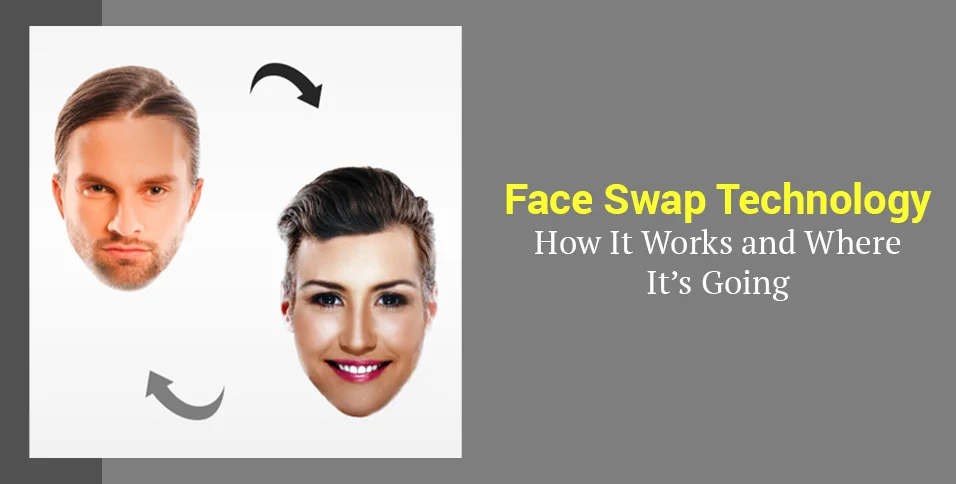
One of the newest innovations in today’s world lies within Artificial Intelligence – face swapping. What was once a Hollywood special effect or a tool in research now is becoming more available for everyday use. Although face swap technology has its uses in wild videos posted online or in glimpses of what Virtual reality could become, it brings with it more pressing issues.
AI Face Swap and its Entrenched Concepts and Technologies
Utilizing deep learning, or more specifically Generative Adversarial Networks, AI face swap technology aims at doing just that— swapping faces over digital images or videos. As a byproduct of AI development, these models are capable of ‘mimicking’ or ‘creating’ human features thanks to dataset files that contain numerous facial characteristics and expressions.
This unique AI face swapping technology is capable of editing facial images into videos or pictures so that the images appear flawless. This goes far beyond mere “face filters” which turn out to be images on a much larger scale such as a video where the light, angle, and skin tone all coincide to swap one person with another momentously.
Enhancing Inventiveness in Content and Content Creation for Various Goals
Transforming the Film and Television Landscape
With AI Face Swap, a new door to creativity has been opened in the entertainment industry. This is because filmmakers are now able to enhance performances in ways that were once either too costly or not feasible at all. One such enhancement is the AI face swap feature, which reduces the need for extensive reshoots and allows for the subtle enhancement of an actor’s performance such as changing the expression on their face. All this could potentially eliminate the need for reshoots and as a result allow the use of virtual actors that do not need to be physically present to act.
Improvements in Gaming and Virtual Reality
Also, AI face swapping technology has transformed the gaming industry and virtual reality (VR) as well. Gamers can customize avatars that are not only more realistic but also provide a better sense of self, or they can create a completely new one. Users can experience more engaging content in VR, such as interacting with facial expressions and emotions within the context of the environment in a highly realistic manner.
Social Media and the Democratization of Digital Identities
Indisputably AI face swapping has now evolved from being a tool to being a culture. Consequently, it is easy to understand why AI face-swapping has gained popularity in the online and social media realms. Snapchat and Instagram allow users to upload videos with face-swapping filters that have become entertaining or trendy to create their advertisements. In this realm, the tool technology gives faces to the characters by enabling the users to switch their faces with those of their friends, stars, or even cartoons.
Furthermore, the use of artificial intelligence (AI) in face swaps is even revolutionising video production and editing processes, enabling rapid changes to scenes and boosting the overall quality of materials produced effortlessly. AI-generated content has become almost ubiquitous with social media, and it is now predominantly found on feeds created to amuse, lampoon, or simply for fun.
Virtual Identity and the Changing Perception of Self
Exploring New Facets of Digital Identity
Thus, we can also phrase this understanding of the digital self – work in progress. Virtual identities are unsettling in the way that users can create and modify their virtual targets in such an unpleasant manner that they can despise their actual physical form. Now, people can live uncontested as female, male, or really any mix thanks to advanced technology without being held back by conventional notions such as reality. New discussions can be raised about the relationship between online self-image and the real self, self-image etc., personal evolution and online identity throughout time.
Reinventing themselves as personalities: the celebrities and the influencers
Face swap applications have become a great tool for celebrities and influencers enabling them to undergo a metamorphosis in the way they choose to depict themselves to the masses. This adjustment of the body which is entirely digital has distorted reality and fantasy allowing art to flourish but at times causing disagreements on what is real or what is fake.
Concern with face-swapping technology
AI face swapping as much as it allows great creativity brings up ethical concerns and security threats. Switching faces in a funny video is fantastic but this technology can be made to cause destruction as well.
Deepfakes Videos and Negative Propaganda
Deep fakes videos, in which someone fabricates a scene and makes it appear that the person is saying or doing something they have never said or done, pose a severe threat. Such videos can distort public perspective, tarnish reputations, and be used for other political agendas. They are a likely weapon for propagandizing sentiments in the public eye making such things as videos and images instilled with truth and belief that much harder to uphold.
Violations of Privacy
Privacy is the other primary concern of nagging proportion. With the advancement of AI face swapping technology, the abuse of using the face of some people without their authority becomes greater. There is a lot of law and personal privacy intrusion if one can portray someone in a video or picture without any permission whatsoever.
Consent and Manipulation of AI Systems
The capability of creating realistic prosthetics without the knowledge of the individual providing stimuli raises the red flag of ethical Intelli Predictive stimulus. The assimilation of fact and fiction undermines the fabric of informed and willing consent becoming the critical factor in personal rights and repatriation of interest in the image of a person.
Implications of Using AI Face Swap in the Future
AI face swap technology is then going to undergo a gradual change still with regards to its use in altering the human face in a photo or moving images. The altercation of such images by professionals brings with it a revival of responsible practice which is often unheard of in the era of digital update. With the more widespread usage of the digital platform, there will be regulations on copyright and image ethics for example unauthorized likeness will be raised.
There will have to be the participation of governments, social media companies, and tech companies in developing frameworks that will regulate the integrities of AI face swapping. This may entail finding better ways of detecting fake or altered images and introducing policies regarding rights and consents that are easy to understand and follow.
Conclusion: New Age in Digital Transformation
There is no arguing that AI face swap technology is the future of digital interactions, creations, and identities. In every step AI is breathing new life into media production, content creation for social media, offering new means to express, entertain, and interact in the digital realm. However, the wide usage comes with responsibilities too. It is indeed very important, as this technology further develops, to be able to keep a balance between progress and ethics – and the ultimate goal here, to make sure the technology improves rather than degrades the digital world. AI face swapping will be possible for many with the help of technologies, but not moderating its risks will be a great barrier.
